How to apply for an NPI number (National Provider Identifier)
November 16, 2026
If you're about to write your first prescription, order a test, or refer a patient, you'll need a National Provider Identifier (NPI) number. Most physicians apply online through the National Plan and Provider Enumeration System (NPPES). This guide covers who needs an NPI, what to have ready, how to apply, how to find a number you already have, and how to keep your record current.
What is a National Provider Identifier (NPI) number?
A National Provider Identifier (NPI) is a unique, 10-digit identification number issued by the federal government to individual healthcare providers. Organizations such as clinics, hospitals, pharmacies, and group practices can have one too. It's the standard ID that payers, pharmacies, and other providers use to identify you in transactions covered by the Health Insurance Portability and Accountability Act (HIPAA).
Whether you work in private practice, in a hospital, or as a locum tenens physician, your NPI stays the same. It doesn't change when you switch employers, move, or take a new assignment.
Who needs an NPI number?
Healthcare providers that are HIPAA-covered entities and those that bill Medicare must have an NPI. You'll need one before you submit claims or take part in other standard HIPAA transactions, including:
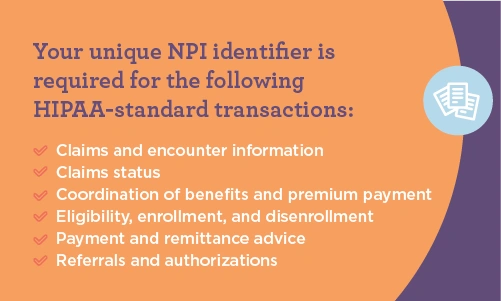
Claims and encounter information
Claim status
Eligibility, enrollment, and disenrollment
Coordination of benefits and premium payment
Payment and remittance advice
Referrals and authorizations
Do residents, fellows, and medical students need an NPI?
Residents, interns, and medical students are all eligible to apply. If you prescribe medications that pharmacies fill, order tests, or refer patients to other providers, you'll generally need one. Many residents apply before they start a new program or job, since employers may ask for the number during onboarding. Planning ahead? Read: A resident's guide to finding your first physician job.
Starting your first physician job search? Browse physician jobs.
What do I need to apply for an NPI number?
Have these ready before you start so you can finish in one sitting:
The reason you're applying (for example, a new NPI)
Identifying information, including your name and Social Security number or Individual Taxpayer Identification Number (ITIN)
Your organization's name and Employer Identification Number (EIN), if you apply on behalf of an organization
Your mailing address and practice location address
Other provider identification numbers you have, if applicable
Your 10-character provider taxonomy code. These alphanumeric codes describe your provider type and specialty, and the National Uniform Claim Committee (NUCC) publishes the full list.
You'll also need a CMS Identity & Access (I&A) account to sign in to NPPES. The first step below walks you through it.
How do I apply for an NPI number?
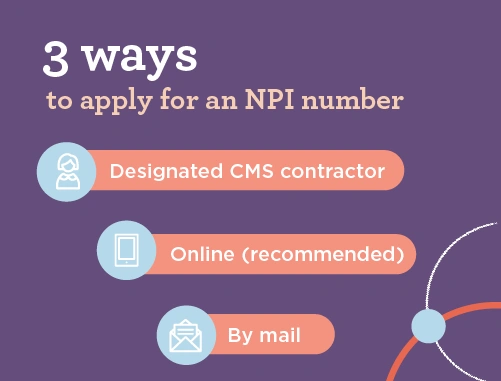
You can apply online, on paper, or through an organization that applies on your behalf. According to the Centers for Medicare & Medicaid Services (CMS), the online application through NPPES is the fastest way. Here's how it works:





Other ways to apply
You can complete and mail a paper NPI application form (CMS-10114). Mailing instructions and the current address are on the CMS page for applying for an NPI. You can also give permission to an Electronic File Interchange Organization (EFIO) to send your application data if one asks for it.
How long does it take to get an NPI number?
CMS says the online application gives you the fastest processing. How long it takes can vary with how many applications CMS is working through, whether you applied online or on paper, and whether your application is complete. Double-check your name, Social Security number, and addresses before you submit to avoid avoidable delays.
Once you have your NPI, credentialing is next. A CompHealth recruiter can walk you through credentialing and licensing. Talk to a recruiter at 800.453.3030.
How do I find my NPI number?
If you already have an NPI, you don't need a new one. Search for yours in the NPPES NPI Registry by name and state. If you don't see it, check your credentialing paperwork, the email you received when you applied, or your employer's medical staff office.
How do I update my NPI record?
Providers are required to report changes to their NPPES record within 30 days. That includes a new practice location, mailing address, name, or taxonomy code. Sign in to NPPES with your I&A account to make the update.
Keeping your record current can also make credentialing smoother, since facilities verify your information as part of the process. If you're moving between jobs or states, see our medical licensing tips and the Interstate Medical Licensure Compact guide for what comes next. Need a DEA registration too? Here's how to obtain a DEA license.
NPI number FAQs
What does NPI stand for?
NPI stands for National Provider Identifier. It's a unique 10-digit number the federal government assigns to healthcare providers for use in HIPAA transactions.
Do residents need an NPI number?
Residents who prescribe medications, order tests, or refer patients generally need one. Residents, interns, and medical students are all eligible to apply.
Does an NPI number expire?
No. An NPI stays the same throughout your career, including when you change jobs or locations. You do need to update your NPPES record within 30 days of changes to your information.
How long does it take to get an NPI number?
It varies. CMS says the online application is the fastest option, and timing depends on application volume and whether your application is complete.
How do I find my NPI number?
Search the NPPES NPI Registry by your name and state. You can also check your credentialing paperwork or the confirmation email from when you applied.
Ready for your next role? Search physician jobs
With your NPI in hand, credentialing and licensing usually come next. A CompHealth recruiter can help you with both and talk through physician jobs, permanent or locum tenens, that fit what you're looking for. Not sure where to start? Read: Your first attending physician job: A guide to finding the right one or 6 post-residency career tips every doctor needs to know.
Are you looking for your first physician job? Check out CompHealth's available jobs or give us a call at 800.453.3030.
Recommended Articles